
Pure Tone Audiometry (PTA)
Hearing changes can happen gradually, making them surprisingly easy to miss. You may notice that people seem to mumble, conversations become harder to follow in restaurants, or you keep turning up the television without realizing it. Sometimes, the change is obvious, such as suddenly struggling to hear with one ear. In other cases, only a hearing test can reveal how much your hearing has changed.
Pure Tone Audiometry, commonly called PTA, is one of the standard tests used to assess hearing sensitivity. It measures how well you can hear sounds at different pitches and volumes and can help identify whether hearing loss is present.
At Garv Diagnostic Centre & Hospital, Dr. Vaibhav Kuchhal, ENT specialist, provides evaluation and guidance for patients with hearing concerns. When appropriate, Pure Tone Audiometry can form an important part of a broader hearing and ENT assessment.
What Is Pure Tone Audiometry?
Pure Tone Audiometry is a behavioral hearing test that measures the softest sounds a person can hear at different frequencies. The test evaluates hearing across a range of pitches rather than checking whether you can hear only one particular sound.
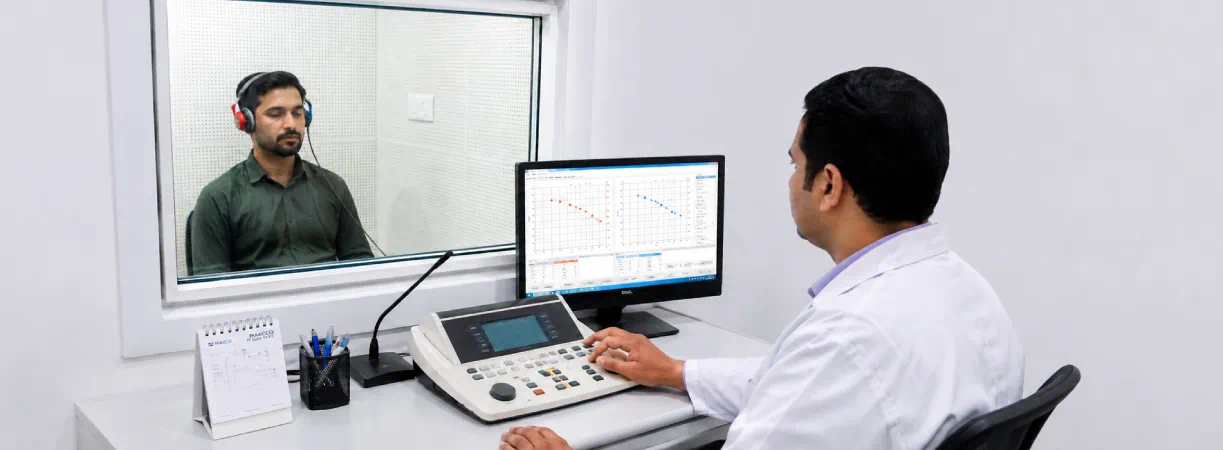
During the test, you typically wear headphones or insert earphones while sitting in a quiet testing environment. Different tones are presented to one ear at a time. Whenever you hear a sound, you indicate that you heard it, usually by pressing a button or raising your hand.
The sounds may become softer or louder depending on your responses. This allows the hearing professional to determine the lowest level at which you can hear different tones.
What Does a PTA Test Measure?
Pure Tone Audiometry primarily evaluates hearing sensitivity. The results can show whether hearing is within the expected range or whether there is hearing loss.
The test typically evaluates different frequencies, including lower and higher pitches. This matters because hearing loss does not necessarily affect every frequency equally.
For example, a person may hear low-pitched sounds relatively well but have difficulty hearing higher-frequency speech sounds. Another person may have a different pattern altogether.
PTA results are generally displayed on an audiogram, which provides a visual representation of hearing thresholds for each ear.
Why Is Pure Tone Audiometry Performed?
A PTA may be recommended when someone reports difficulty hearing or when an ENT examination suggests that hearing should be assessed more closely.
Common reasons for a hearing assessment include:
- Difficulty understanding conversations
- Frequently asking others to repeat themselves
- Hearing loss in one or both ears
- Ringing or other sounds in the ears
- A feeling of ear fullness or pressure
- Recurrent ear infections
- Dizziness or balance concerns
- Exposure to loud noise
- Changes in hearing after certain illnesses or treatments
- Monitoring previously identified hearing loss
A hearing test may also be useful when someone has not noticed any obvious hearing difficulty but has risk factors that warrant assessment.
What Happens During the Test?
A PTA is generally straightforward and does not involve needles or invasive procedures.
Before testing begins, your hearing history and current symptoms may be discussed. The ears may also be examined to identify issues that could affect hearing, such as excessive earwax or other visible abnormalities.
You are then seated in a quiet testing area and provided with headphones or insert earphones. The hearing professional presents tones at different frequencies and intensities.
You simply indicate whenever you hear a tone, even if it is very faint. The test is based on your responses, so it is important to remain attentive and respond whenever you believe you hear a sound.
Testing is usually performed separately for each ear.
Understanding Your Audiogram
The results of Pure Tone Audiometry are recorded on an audiogram. This graph shows hearing thresholds at different frequencies for each ear.
The pattern can provide useful information about the degree and type of hearing loss. Depending on the findings, additional testing may be recommended to understand the underlying cause.
A hearing test by itself does not always explain why hearing loss has occurred. That is why PTA results are often considered alongside the patient's symptoms, medical history, physical examination, and other relevant findings.
Your ENT specialist can explain what your results mean and whether further evaluation or treatment is appropriate.
Is Pure Tone Audiometry Suitable for Children?
PTA can be used for many children who are able to understand and respond reliably to the instructions. The exact approach may vary depending on the child's age, attention span, communication ability, and developmental level.
For younger children who cannot reliably participate in conventional testing, other hearing assessment methods may be considered.
Identifying hearing difficulties during childhood can be particularly important because hearing contributes to speech, language, learning, and communication development.
PTA and Hearing Rehabilitation
If testing confirms hearing loss, the next step depends on its type, degree, and possible cause.
Some hearing problems may be related to conditions that can be medically managed. In other situations, hearing aids or other forms of hearing rehabilitation may be considered.
PTA results can help provide the information needed to determine whether hearing assistance may be appropriate. They can also serve as a baseline for monitoring hearing over time.
How Should You Prepare for a PTA?
There is generally no complicated preparation required for Pure Tone Audiometry. However, it is helpful to tell your healthcare provider about any recent changes in hearing, ear infections, exposure to loud noise, tinnitus, dizziness, or previous ear problems.
If you use hearing devices, bring relevant information about them to your appointment if requested.
Most importantly, try to remain relaxed and attentive during the test. Your responses help determine your hearing thresholds, so responding consistently is important.
When Should You Consider a Hearing Test?
Do not wait for hearing loss to interfere significantly with everyday life before discussing it with an ENT specialist.
Consider a hearing evaluation if you regularly ask people to repeat themselves, struggle to understand speech in noisy environments, increase the volume on your television or phone, or notice a difference between your ears.
Sudden hearing changes should receive prompt medical attention, particularly when accompanied by other symptoms.
A hearing test can provide useful information about your current hearing and help determine whether further evaluation is needed.
Move Forward With Better Hearing Care At Garv Diagnostic Centre & Hospital
Hearing changes can be easy to overlook, but a simple hearing assessment can provide valuable information about how well you hear across different frequencies. Pure Tone Audiometry is a commonly used test that helps establish an individual's hearing thresholds and can support further ENT evaluation when needed.
If you have noticed changes in your hearing or are concerned about your ability to follow conversations, consult Dr. Vaibhav Kuchhal, ENT specialist, for an appropriate hearing assessment and personalised guidance.
Frequently Asked Questions
Q: Is Pure Tone Audiometry painful?
A: No. PTA is a noninvasive hearing test. You listen to different tones through headphones or insert earphones and indicate when you hear them.
Q: How long does a PTA test take?
A: The duration can vary depending on the individual's hearing concerns and whether additional testing is required. A standard hearing assessment is generally completed within a relatively short appointment.
Q: Can PTA detect hearing loss in one ear?
A: Yes. Hearing is generally tested separately in each ear, allowing differences between the ears to be identified.
Q: Does PTA determine the cause of hearing loss?
A: PTA identifies hearing sensitivity and patterns of hearing loss, but additional evaluation may be needed to determine the underlying cause.
Q: Can children undergo Pure Tone Audiometry?
A: Yes. Many children can undergo PTA if they are able to understand and respond to the test instructions. The testing method may be adapted according to the child's age and abilities.
Q: What happens if my PTA shows hearing loss?
A: Your ENT specialist can review the results along with your symptoms and examination findings. Depending on the cause and severity, recommendations may include medical treatment, monitoring, further testing, hearing devices, or rehabilitation.



Office Hours
Mon–Sat: Open 24 Hours
Sun: 8:00 AM–2:00 PM


©2026 | Garv Diagnostic Centre & Hospital | All Rights Reserved | Digital Marketing By Remedo